Your New Digital Colleague
To truly get the most out of AI, simply learning its functions is not enough; you need to undergo a slight mental shift in how you view the tool. Most of us are accustomed to using search engines like Google. When using a search engine, we enter specific keywords (e.g., “restaurant Stockholm open Sunday”), press enter, and expect a list of exact links to existing answers. If you treat your AI assistant in the same manner, like a glorified search engine, you will be deeply disappointed and miss the entire point.
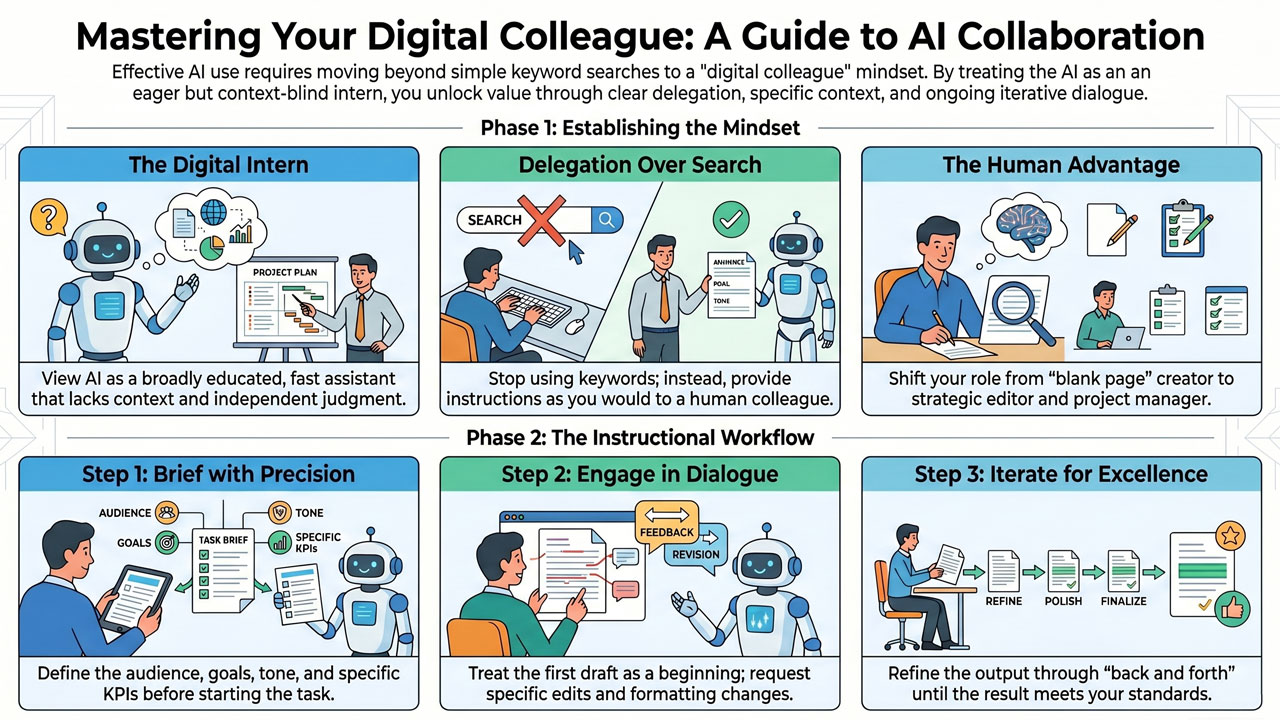
Instead, you should regard the AI as a new, digital colleague. More specifically: an extremely broadly educated, lightning-fast, and eager intern. This intern has read all the books in the world, speaks all languages fluently, and can write at the speed of light. However, the intern lacks life experience, context regarding your specific workplace, and possesses no judgement. It does exactly what you ask of it, neither more nor less.
Working with an AI assistant is therefore a matter of delegation and dialogue. When you ask a human colleague for help writing a report, you do not walk up to the person’s desk, shout “Sales report Q3!” and walk away. You provide context, explaining who will read the report, what the goal is, what tone is expected, and which key performance indicators must be included. You must provide your digital colleague with exactly the same care and clear frameworks.
Another important perspective is precisely the dialogue. Many users write an instruction to the AI, receive an initial response that is not entirely perfect, and conclude that “the AI was poor at this”. But with a human colleague, you would probably have said: “Good first draft, but could you shorten the introduction, add a paragraph about our new product, and make the tone a bit more sales-oriented?”. You must do the same with the AI; you are having an ongoing conversation. If the first answer is too long, ask it to shorten it. If it is too dull, ask it to insert a suitable metaphor. It is in this iterative process – back and forth – that the real value is created.
Your digital colleague is also available 24 hours a day. It never becomes stressed if you ask it to rewrite a text fifteen times. It never rolls its eyes if you ask a “stupid” question because you want to understand a complex topic better. By beginning to interact with your AI as a patient and capable assistant, you shift your own work from being the one staring at a blank piece of paper, to being an editor and project manager directing the outcome. This digital colleague elevates your working day by giving you the luxury of an infinite mental resource, allowing you to focus on what truly requires human finesse, empathy, and strategic thinking.