From Words to Action
Your eyes have been opened to the technology, you know how it functions, and you have created an account with one of the major AI assistants. But how does one take the step from testing the tool for fun, to actually making it a natural and productive part of the workplace’s DNA? Implementing AI in practice is less about technology and much more about behavioural change, routines, and culture.
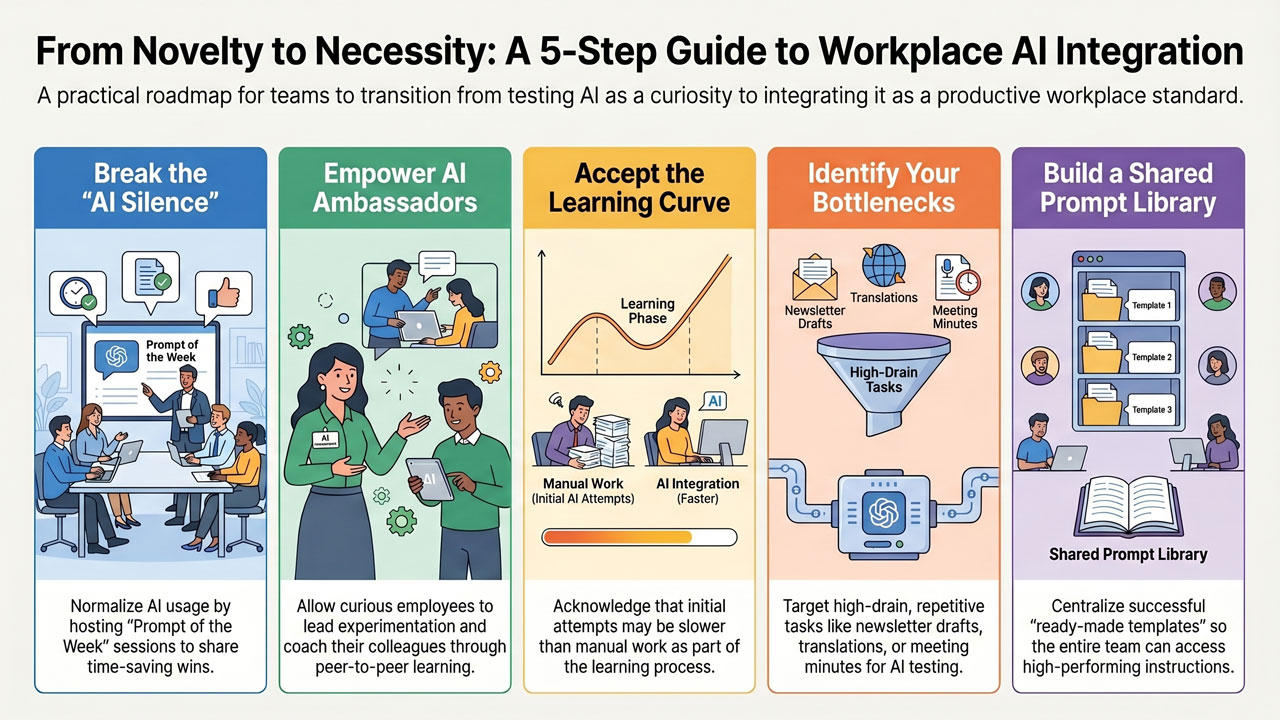
Firstly, we must break the “AI silence” in the workplace. Many employees today use AI secretly, somewhat worried that it might be perceived as cheating or not doing one’s job properly if one allows a computer to write the first draft. This attitude must be reversed to its opposite. Create a climate where sharing how one uses the tools is devoid of prestige and actively encouraged. A highly effective way to begin is to introduce a standing item in your weekly meetings called “Prompt of the Week” or “The AI Win”. Allow an employee to showcase a concrete example of how they used AI to save time during the week. This demystifies the technology and spreads practical knowledge directly within the team.
Secondly, it is about identifying your “bottlenecks”. Look at your own and your team’s working week. Which tasks are repetitive, administrative, and drain an unnecessarily large amount of mental energy? It could be writing standardised quotes, summarising lengthy tenders, translating manuals, or writing weekly newsletters. Select one or two of these specific processes and decide to test them with AI for a month. Make it a joint challenge to build up an internal library of “ready-made templates” (good prompts) that the entire team can utilise. If one person finds the perfect way to ask the AI to structure client meeting minutes, everyone in the group should be given access to that instruction.
Another successful concept is to appoint “AI ambassadors”. Instead of top-level managers dictating exactly how the tool should be used, let the employees who are most curious lead the way. Give them a little extra time to experiment, and then let them train and coach their colleagues. We learn best from those we work closest with.
To move from words to action also requires an acceptance that things will sometimes go wrong in the beginning. The learning curve is not perfectly straight. Sometimes you will spend twenty minutes getting the AI to do something, only to realise that it would have been quicker to do it yourself from the start. That is perfectly fine – it is part of the process of getting to know the tool’s strengths and weaknesses. By starting with harmless tasks, sharing insights openly, and systematically attacking time-consuming routines, AI will soon transform from an exciting novelty into an indispensable tool in your daily operations.