Understanding the Technology
When you see an AI write a perfectly structured project plan in three seconds, it can feel like pure magic. However, in order to utilise the technology in the best possible way, it is important to pull back the curtain and understand what is actually happening “under the bonnet”. You absolutely do not need to be a systems developer or mathematician to understand the fundamental principles, but a basic understanding demystifies the technology and makes you a more skilled procurer.
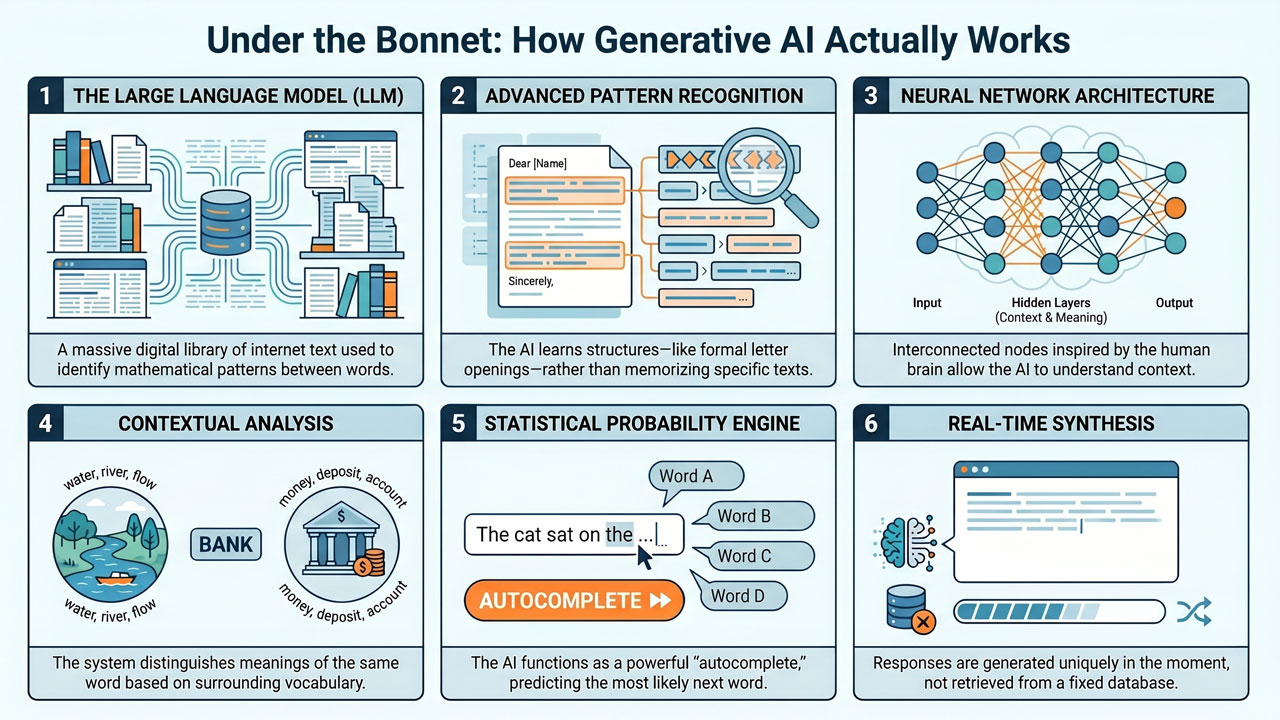
Generative AI for text, which we focus heavily upon here, is built upon something called LLM – Large Language Models. Imagine that you possess a gigantic, invisible library containing almost all text ever published on the internet: books, scientific dissertations, forum threads, news articles, and poetry in hundreds of different languages. Researchers have allowed a powerful computer to “read” all this material. The computer’s task was not to memorise the texts by heart in order to copy them, but rather to discover mathematical patterns and connections between words.
It has learned how human language is structured, understanding that the word “warmly” is often followed by “welcome”, and that a text beginning with “To whom it may concern” is likely a formal letter. In its absolute simplest, most distilled form, an AI assistant actually functions as an extremely powerful version of the automatic fill-in (autocorrect/autocomplete) feature you have on your mobile telephone. When you write a text message and the telephone suggests the next word, it is based on what you usually write. When a Generative AI writes a text, it is based on probability calculations trained on billions upon billions of data points.
Another important concept is neural networks. This is the underlying architecture, loosely inspired by how the human brain functions, with millions of interconnected nodes (“brain cells”). This network enables the AI to understand context. It understands the difference in meaning of a word depending on whether you are talking about breakfast, cars in traffic, or a document on your computer, based on which other words are in the vicinity.
Thus, when you ask your AI assistant a question, it does not search a database for a ready-made answer. It does not look up a website and paste the text for you. Instead, based on your question, it begins to calculate exactly which word ought to come first in the response with the greatest statistical probability. Then it calculates the next word, and the next. It generates the text in real-time, uniquely for you. That is why you can ask it to write something as absurd as “a job advertisement for an astronaut in the form of a Shakespearean sonnet” and receive a brilliant result. It combines the pattern for a job advertisement, the pattern for astronaut terminology, and the pattern for 16th-century poetry in an entirely novel manner. Understanding that the AI is an advanced pattern recogniser and probability engine – not a thinking being – is the key to both maximising its potential and understanding its limitations.