Welcome to the Prompt Guide
Welcome to the concluding, and perhaps the most practical, part of your AI Driving Licence. Up until now, we have discussed what the technology is, how you should approach it purely from a security perspective, and how you can begin to build the correct mental attitude. Now it is time to place your hands on the steering wheel. The core of all practical AI work boils down to a single, exceptionally central concept: prompting.
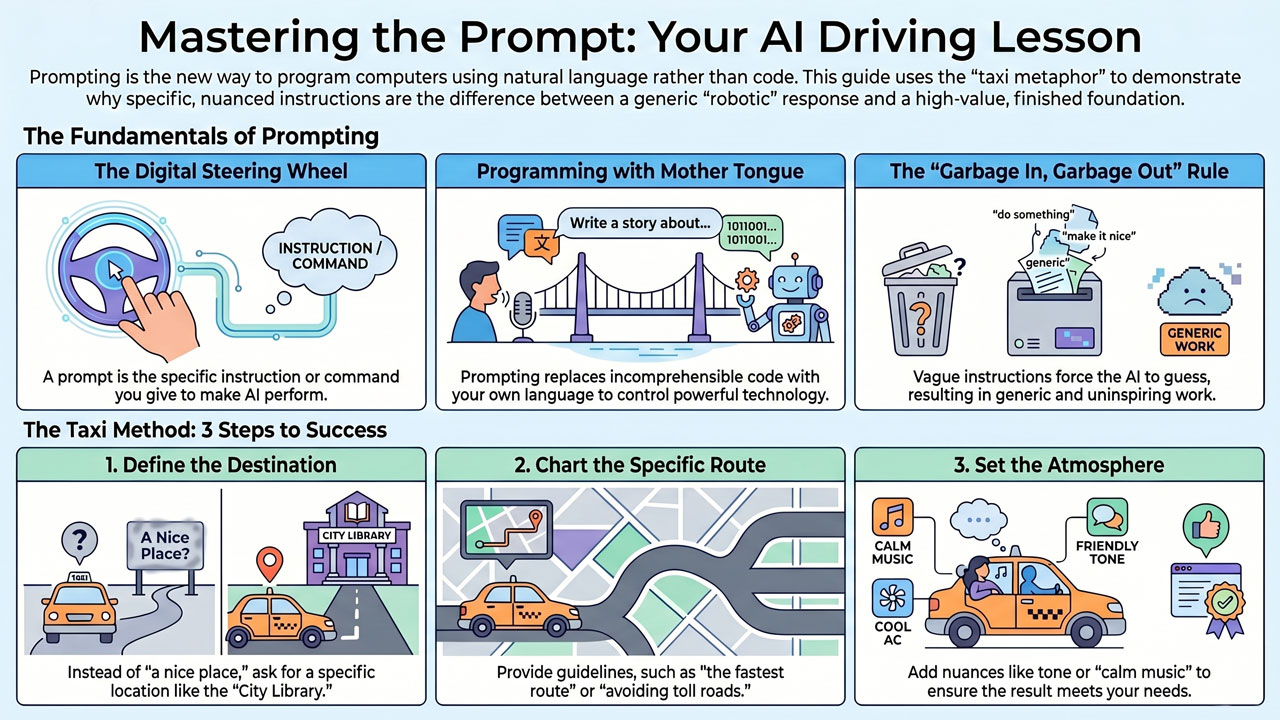
A “prompt” is quite simply the instruction, the question, or the command you give to the AI assistant to make it perform a task. Writing a prompt is fundamentally the new way to programme computers. Instead of writing incomprehensible code filled with brackets and semicolons, you programme the machine using your own mother tongue. Your ability to formulate clear, rich, and strategic prompts is what determines whether the AI delivers a flat, dull standard response or a brilliant, finished foundation that saves you hours of work.
To understand the importance of a good prompt, I usually employ the taxi metaphor. Imagine that you jump into a taxi and say to the driver: “Drive me to a nice place.” The driver (the AI) will absolutely drive you somewhere. However, the chance that you end up exactly where you actually wanted to be is microscopic. You might end up at a loud nightclub when you actually wanted to go to a quiet library, because “nice” means different things to different individuals. If you instead sit in the taxi and say: “Drive me to the City Library, take the fastest route that avoids toll roads, and please, play some calm classical music during the journey,” then you will receive exactly the experience you asked for.
Within the AI world, one often speaks of the principle “Garbage in, garbage out”. If you give the AI a vague, fuzzy, and brief instruction, it has to guess what you want. The result is often generic and uninspiring. If, for example, you merely write “Write an email to a dissatisfied customer”, you will receive a standardised robotic email in return. It is when you begin to add details, nuances, and guidelines that the magic occurs.
Mastering the art of prompting is about learning to break down one’s thoughts and needs into clear components. It is about becoming an exceptionally good procurer. The more specific you can be regarding what you wish to achieve, who the recipient is, and what the final result should look like, the more value you will extract from your digital colleague. In the next section, we will go through a proven method for structuring your instructions so that you always achieve the best possible result.