Sustainability and Environmental Impact
When we work with AI, it is easy to believe that everything takes place in a weightless, digital space with no physical impact on our planet. We see neat text appear on the screen and rarely consider the enormous resources required behind the scenes. But the truth is that AI has a significant environmental footprint. As a responsible AI user, it is important to understand that every prompt has a price in the form of energy and water, and that we should use the tools with a degree of reflection.
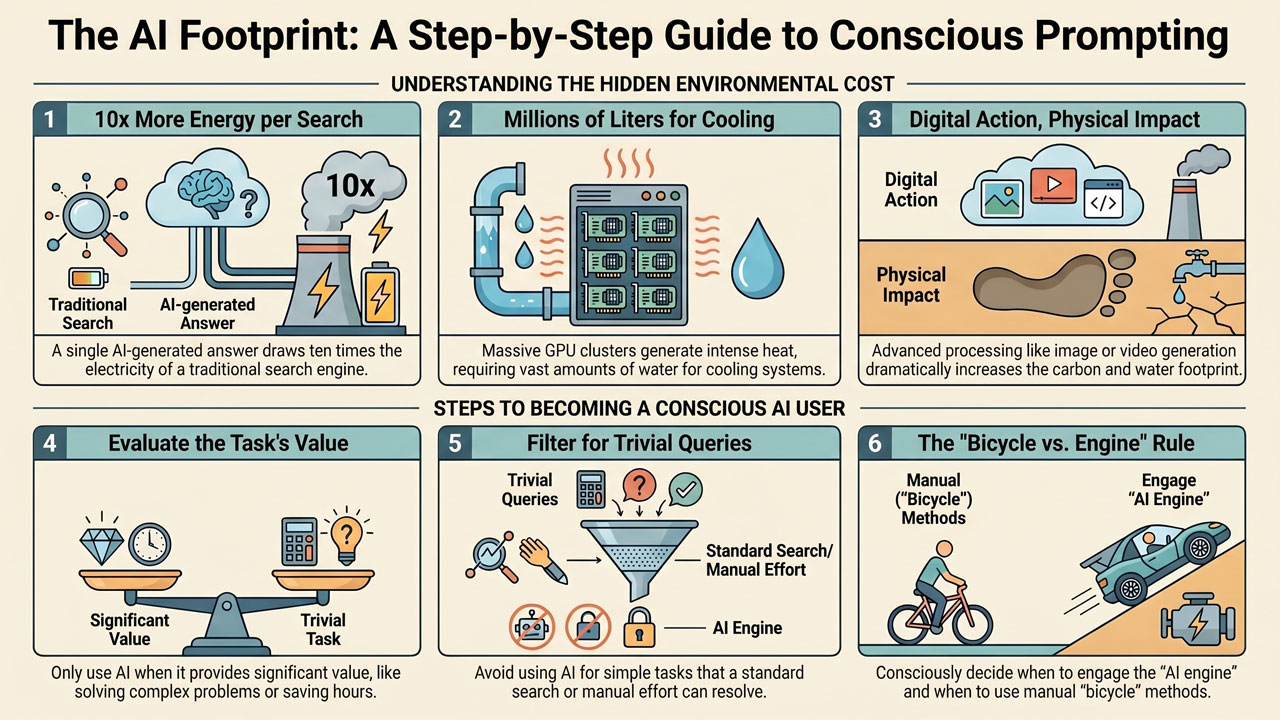
For an AI to be able to answer your questions, massive server farms filled with thousands of powerful graphics cards (GPUs) are required. These processors work extremely hard to execute the billions of calculations necessary to generate a single answer. This process draws vast amounts of electricity. Studies have shown that a single advanced search using an AI assistant can draw up to ten times as much power as a standard search in a traditional search engine. If we furthermore begin generating images or video, energy consumption increases dramatically.
But electricity is only one half of the equation. All of this computing power generates enormous amounts of heat. To prevent the server farms from melting down, advanced cooling systems are required, which often consume millions of litres of water. In areas where water scarcity is a reality, AI usage becomes a direct ethical and environmental issue. As part of modern sustainability efforts, companies must now begin incorporating their AI consumption into their climate reports.
Does this mean that we should stop using AI? Absolutely not. AI can in itself be a fantastic tool for solving the environmental crisis, for example by optimising energy systems or assisting scientists in developing new, sustainable materials. However, it is about being a “conscious consumer”. Use AI where it provides actual added value – when it saves you hours of work, helps you think creatively, or solves complex problems. Avoid using it for trivial matters that you can easily do yourself or that a standard search could resolve. By using the technology smartly and efficiently, we ensure that we benefit from the AI revolution without burdening the planet more than necessary. Possessing an AI driving licence also entails knowing when to let the engine run and when it is better to take the bicycle.