The Human at the Helm
One of the most common misunderstandings surrounding generative AI is that the machine knows what is true and false, right and wrong. Because the AI formulates itself so incredibly convincingly, with perfect grammar and rock-solid self-confidence, it is easy to be lulled into a false sense of security and believe that it is infallible. But the truth is that the AI lacks something fundamental that you as a human possess: a moral compass, contextual understanding, and legal responsibility.
In the AI world, one often speaks of the concept of “Human-in-the-loop”. This means that regardless of how advanced the technology becomes, it is always you, the human, who stands at the helm as captain.
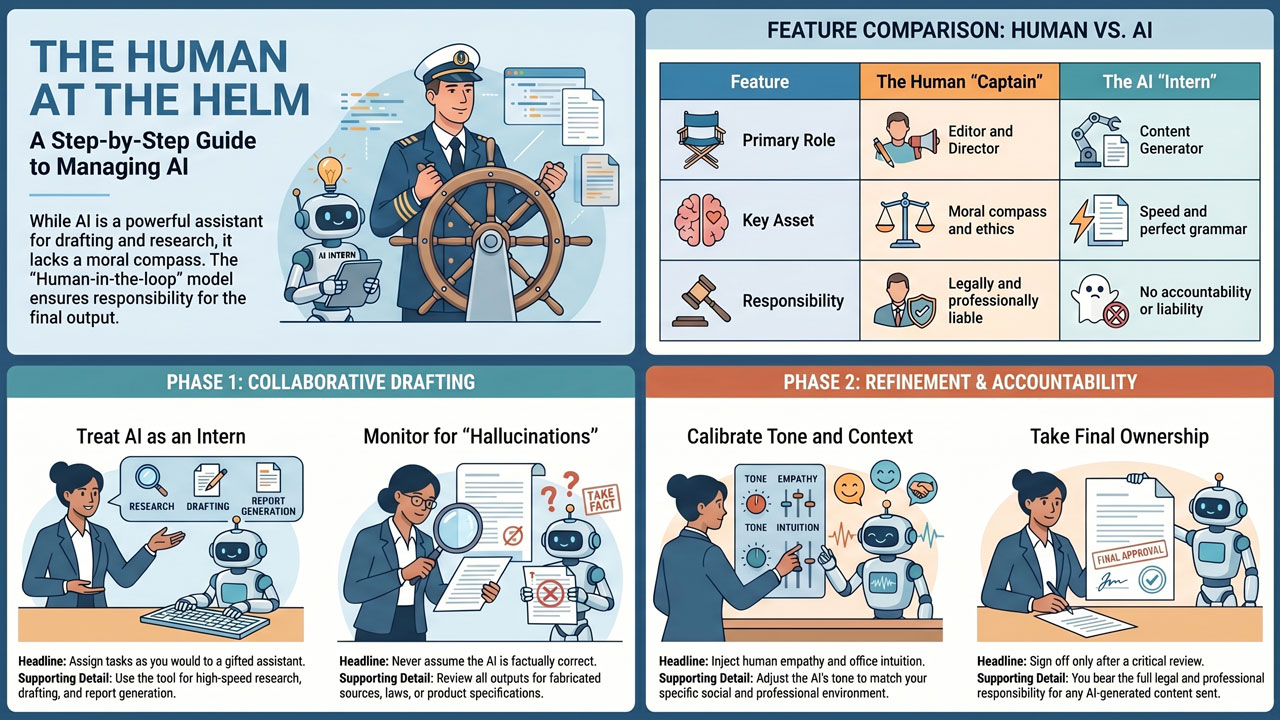
Imagine that you have an extremely fast, eager, and gifted intern at the office. The intern is fantastic at producing drafts, conducting research, and writing reports. But you would never allow the intern to sign a legally binding agreement on behalf of your company, or send out an important press release to thousands of recipients without you first reading through, fact-checking, and approving the material. You must adopt exactly the same approach towards AI. The tool is your assistant, but it is your name, your professional reputation, and your employer’s brand that are at stake.
Why is this so crucial? First and foremost, it is because AI is sometimes wrong, a phenomenon that we will examine more closely in part B under the concept of “hallucinations”. Because the AI is an advanced guessing machine, it can sometimes piece together information in a way that sounds completely logical, but which in reality is entirely fabricated. It can invent false sources, cite laws that do not exist, or conflate the specifications of two different products. If you blindly copy and paste a text from an AI and send it to a client, you bear the full responsibility for any inaccuracies. The machine cannot be held accountable, it cannot apologise, and it cannot pay damages.
Secondly, AI lacks the intuitive flair that is built upon your human experiences and values. The AI does not know that your manager has had a bad week, it does not understand the subtle nuances of office politics, and it cannot read the room. A text generated by the AI may be technically correct, but possess an entirely inappropriate tone – it could be perceived as unintentionally passive-aggressive, overly formal, or outright insensitive. You, as a human, must inject empathy, ethics, and common sense into the final product.
Having “the human at the helm” is not a limitation; it is a safeguard. It means that you do not need to worry about the AI stripping you of your expertise. Rather, your role shifts from being the one who produces all text from scratch, to becoming a creative director, an astute editor, and a critical fact-checker. Use AI to increase your capacity and generate the material, but never let go of the helm. Always read, always review, and ensure that the final result represents you and your values before you click “send”.