Summary of Part B – AI in Practice
Here is a short repetition and summary of Part B
-
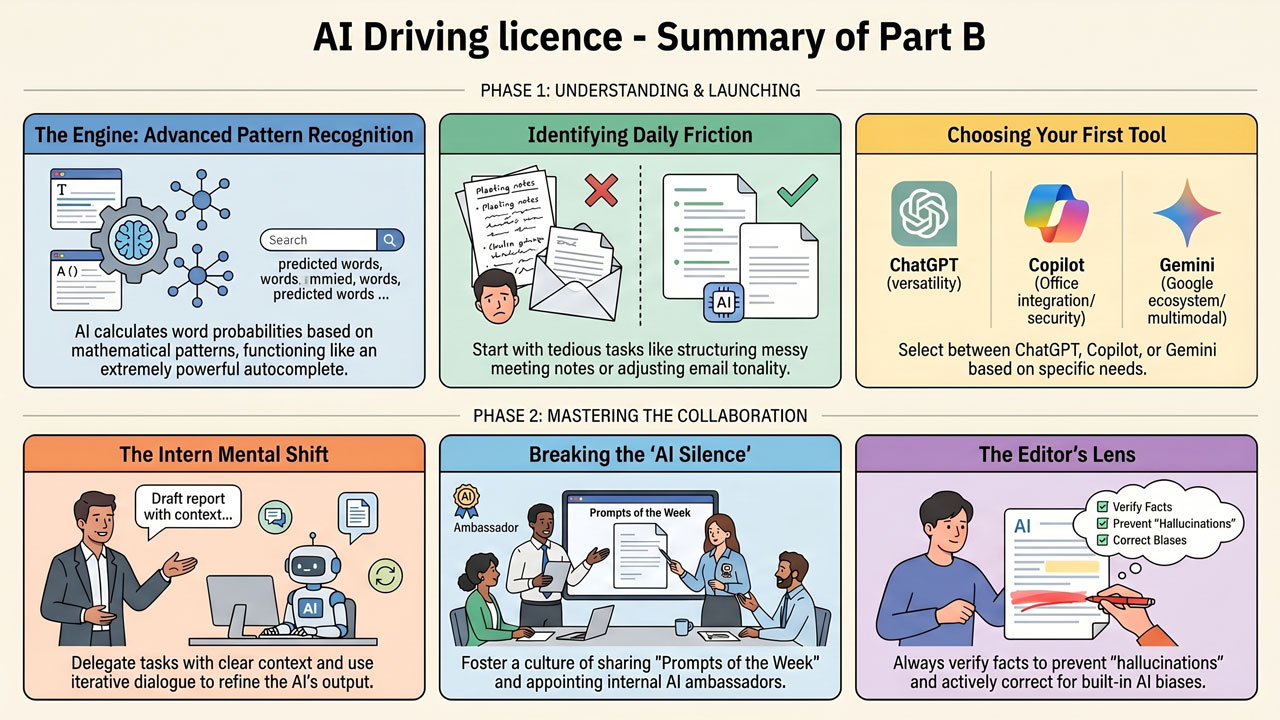
Understanding the Technology: Generative AI is not a search engine, but an advanced probability engine built upon Large Language Models (LLMs) and neural networks. It does not retrieve ready-made answers, but rather generates text uniquely by calculating the most statistically probable next word based on patterns.
-
Getting Started: Begin by identifying “friction” in your working day. The AI excels at structuring disorganised meeting notes, adjusting the tone of emails, translating into professional business English, and acting as a critical colleague to stress-test your ideas.
-
Your Digital Colleague: You should treat the AI as a highly educated, eager intern who lacks judgement and workplace context. To get good results, you must provide clear instructions and engage in an iterative dialogue where you constantly refine and adjust the output.
-
Choosing an Assistant: The three major tools are ChatGPT (versatile and human-like), Microsoft Copilot (secure and deeply integrated into the Microsoft ecosystem), and Google Gemini (multimodal and integrated into Google Workspace).
-
Implementing AI at Work: It is crucial to break the “AI silence” and actively share successful prompts within the team. Identify administrative bottlenecks, share best practices, and appoint “AI ambassadors” to help colleagues overcome the learning curve.
-
Critical Thinking: As AI takes over the production of material, your role shifts to being an editor and fact-checker. You must always remember to “trust, but verify” because AI can confidently fabricate facts (known as “hallucinations”) and reproduce built-in societal biases and stereotypes.