Summary of Part A – The Basics and Responsibility
Here is a short repetition and summary of Part A
-
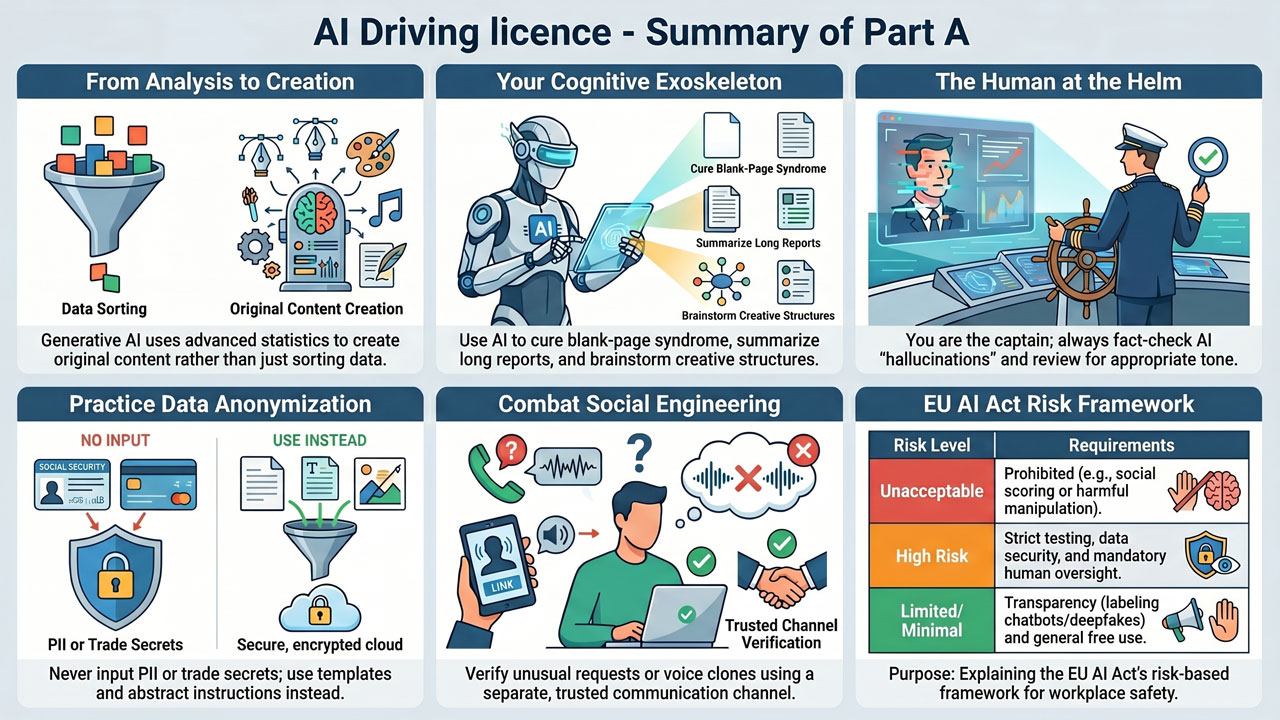
Introduction to Generative AI: Generative AI is revolutionary because it creates entirely new, original content rather than just analyzing existing data. You can control it using everyday language (a process called “prompting”), which has democratized the technology and made it accessible to everyone.
-
Elevating the Working Day: AI acts as a “cognitive exoskeleton” that helps you overcome the “terror of the blank document”, summarizes long reports instantly, and serves as a tireless brainstorming partner. Delegating these administrative tasks frees up time for uniquely human skills like empathy, relationship building, and complex problem-solving.
-
Navigating Safely (Privacy & Security): You must never input personal data, medical information, or trade secrets into open AI tools, as this information may be used to train the AI. Instead, use anonymization and abstraction to safely get help with structures or templates.
-
AI-Driven Security Threats: Generative AI is being used for sophisticated “Social Engineering” attacks, including linguistically flawless phishing emails and “Deepfakes” (cloned audio or video of colleagues or executives). Your best defense is a “healthy scepticism” and verifying unusual requests through alternative communication channels.
-
Copyright and Intellectual Property: Under current law, AI-generated content generally lacks copyright protection because it is not created by a human. To claim ownership and avoid infringing on the rights of others, you must heavily edit and inject your own human creativity into the AI’s raw material.
-
The EU AI Act: This is the world’s first comprehensive AI legislation, built on a risk-based tier system (Unacceptable, High, Limited, and Minimal risk). It aims to ensure that AI systems are safe, transparent, and do not threaten democratic values or fundamental rights.
-
Sustainability and Environmental Impact: AI has a massive environmental footprint due to the enormous amounts of electricity and water required to power and cool server farms. You should be a “conscious consumer” and reserve AI usage for complex tasks rather than trivial matters.
-
The Human at the Helm: AI is highly confident but lacks a moral compass, contextual understanding, and legal responsibility. Because AI can fabricate information (“hallucinate”) or output inappropriate tones, you must always remain in control as an editor and fact-checker, bearing full responsibility for the final result before you use it.