Next-Level Prompting (Contextual Examples and Iteration)
Once you have mastered the 6-step model we went through earlier in the course, you possess a tremendous advantage. Your texts will be sharper and your results more accurate. However, to be able to call yourself a true “AI pilot”, there are two slightly more advanced concepts within prompting that you must know. These techniques take you from being a good procurer to becoming a strategic engineer of your own workflow. The techniques are often referred to as “Few-shot prompting” and “Chain of Thought”.
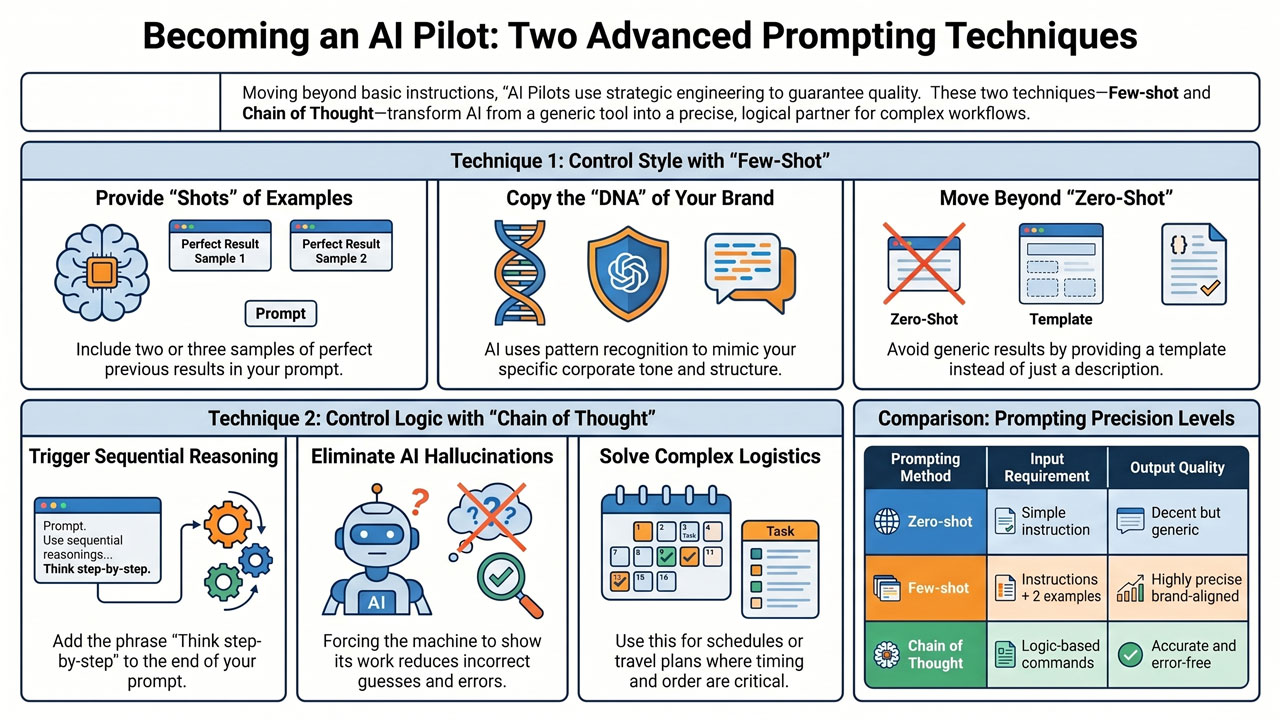
Few-shot prompting (Leading by Example)
Even with a perfect instruction, it can sometimes be difficult to get the AI to hit exactly the unique tonality or structure that your specific company uses. “Few-shot prompting” solves this. Instead of merely describing what you want (which is called Zero-shot), you include a couple of examples (shots) of what a perfect final result looks like. AI models are formidable at pattern recognition, and when they see your examples, they immediately copy the “DNA” you have provided.
Imagine that you want to write product descriptions for your webshop. You might write: “Write a sales text about our new wool socks.” The AI will do a decent job. But if you instead write: “Here are two examples of how our product descriptions usually sound. Example 1: (Paste a previous, good text). Example 2: (Paste another previous, good text). Now, write a text about our new wool socks in exactly the same format and tone as the two examples.” The result is now astonishingly precise, adapted to your corporate culture, and immediately ready for publication. You have not only given the AI a task; you have given it a ready-made template to mimic.
Chain of Thought (Thinking step-by-step)
One of the greatest problems with generative AI is, as is well known, hallucinations (when it guesses incorrectly but sounds certain). This most often occurs when one asks a highly complex question where the AI must jump directly to a difficult final answer without reasoning along the way. “Chain of Thought” is an extremely powerful method for forcing the AI to slow down and break down its own work.
The method is ridiculously simple: you quite simply add the phrase “Think step-by-step” or “Explain how you arrived at this before you give the answer” in your prompt. Imagine that you are planning a logistically complicated conference where several speakers, breaks, and journeys must click into each other. If you ask the AI to produce a detailed schedule, it can easily miscalculate travel times or double-book a room. However, if you conclude your prompt with “Explain your logic step-by-step for each time slot”, you force the probability engine to first calculate step one, which makes step two more correct, and so forth. You are asking the machine to show its workings, exactly as a mathematics teacher does.
By using contextual examples (Few-shot) to control style, and chains of thought (Chain of Thought) to control logic and reduce margins of error, you elevate your prompting to a professional level. It is about iterating, getting to know the tool’s limitations, and actively building frameworks that guarantee quality.