Navigating Safely in the AI Landscape
When you obtain your standard driving licence, you do not solely learn how to start the engine and change gears; you must also understand the traffic rules, learn to read signs, and know how to act at intersections. The same principle applies to your “AI Driving Licence”. Now that you know how powerful the engine (generative AI) is, we must look at what rules apply out on the roads so that you do not crash or drive into the ditch. Navigating safely in the AI landscape is fundamentally about information security, privacy, and adhering to your workplace’s policies.
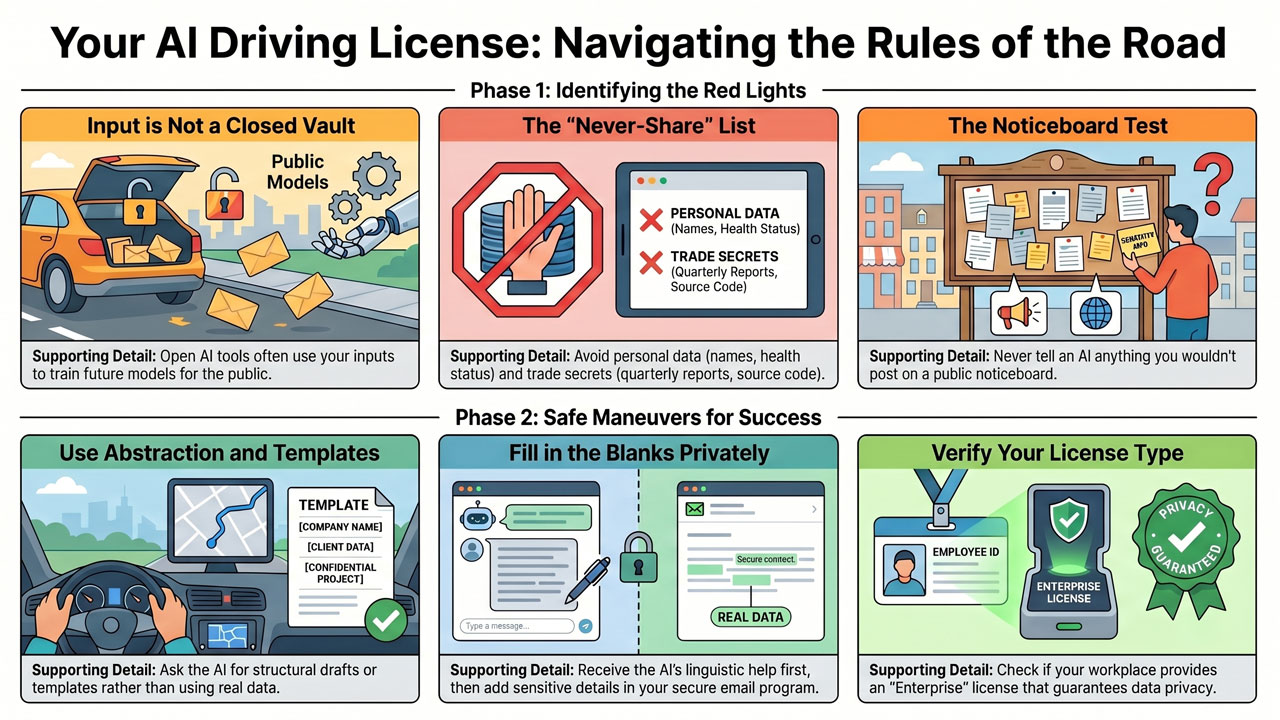
The most important thing you must remember when using open AI tools is that the information you input can often be used to train the AI model further. You are thus interacting with an external system, not a closed vault on your own computer. Therefore, there are clear boundaries regarding what you are permitted to share.
Let us consider a concrete scenario: You are an HR manager and need to write a difficult email to an employee regarding an ongoing rehabilitation process. It might be extremely tempting to paste medical certificates, the employee’s name, and previous email conversations into your AI assistant to ask it to formulate an empathetic and professional response. Never do this. When you share personal data – names, personal identity numbers, addresses, health status, or other information that can be linked to a living individual – you are not only violating internal rules, but likely also the GDPR (General Data Protection Regulation).
The same strict caution applies to trade secrets. You must absolutely not upload unreleased quarterly reports, secret source code, strategic business plans, or customer registers. If the information is confidential to your company, it is confidential to the AI.
How, then, should you use AI for these tasks? The answer lies in anonymisation and abstraction. Instead of pasting in real data, you ask the AI for help with the structure. You can write: “Act as a professional HR expert. Provide me with a template for how I should structure an email to an employee who is undergoing a rehabilitation process. The tone should be supportive but formal.” In this way, you obtain the perfect draft and linguistic assistance, but you fill in the sensitive details yourself in your own secure email programme.
Many modern workplaces currently have (or are in the process of developing) their own AI policies. It may also be the case that your employer has procured a corporate version of an AI assistant (a so-called “Enterprise” licence) where the agreement guarantees that your data is not used for training and remains within your walls. It is your own professional responsibility to ascertain what applies specifically at your workplace. But as a golden rule of thumb: Treat an open AI assistant like an incredibly smart colleague who unfortunately has a habit of speaking out of turn on the bus. Do not tell the AI anything that you would not be comfortable reading on a public noticeboard.