Critical Thinking
As AI takes over more and more of the heavy, repetitive grunt work and produces convincing texts, analyses, and images on an assembly line, an interesting shift occurs in your role in the workplace. From having been the producer of material, you increasingly become the editor and fact-checker. For this exact reason, critical thinking is by far your most important trait in an AI-driven world. You must be prepared to question what is presented on the screen in front of you, regardless of how professional and articulate it appears.
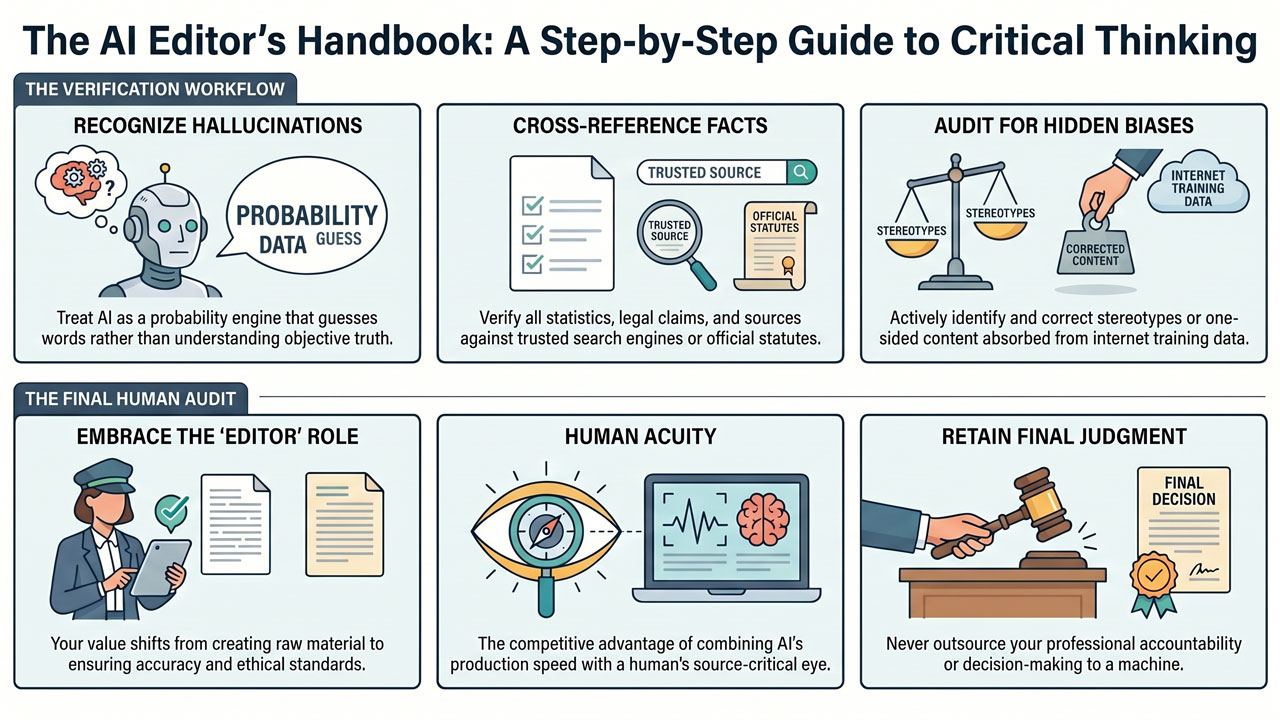
The absolute greatest threat to successful AI usage is the phenomenon known in research as “hallucinations”. When an AI hallucinates, it means it generates an answer that is factually incorrect, fabricated, or completely pulled out of thin air – but it does so with one hundred percent, unwavering confidence. Let us remind ourselves of how the technology works: the AI is an advanced probability engine that guesses which word should come next. It possesses no ability to understand truth, ethics, or objective reality.
Imagine that you ask an AI to recount “the great Swedish-Norwegian penguin crisis of the 19th century”. Instead of saying “I can find no information about that, it does not appear to have happened”, there is a risk that it kindly and sympathetically invents a fantastic, historically resonant narrative complete with fabricated dates, diplomatic complications, and outraged royalty. It does this because you asked it to tell a story, and it tries to be accommodating by piecing together words related to history, diplomacy, Norway, Sweden, and penguins. It is not lying out of malice; it is merely striving to complete the pattern.
Therefore, the rule “trust, but verify” must echo in your mind every time you use AI in your profession. Does the AI produce statistics in your report? Ask it for the source, or even better, double-check the statistics yourself in a trusted search engine. Does the AI claim that a certain Swedish law applies in a specific employment law matter? Verify this against the statute book or your legal counsel. You can never, under any circumstances, outsource your judgement to the machine.
Critical thinking is also about being aware of built-in biases, meaning prejudices. Because AI models are trained on gigantic amounts of text from the internet, they absorb all of humanity’s opinions, stereotypes, and historical distortions. If you ask an AI to generate an image of a “successful CEO”, the chance (or rather the risk) is high that it draws a middle-aged man in a suit. If you ask it to describe a nurse, the language may unconsciously assume a specific gender role. It is your responsibility as a user to see through these structures and actively correct the AI when it produces one-sided or stereotypical content.
Becoming skilled at AI is thus not primarily about technical brilliance, but about human acuity. The individual who can combine the AI’s enormous production capacity with a razor-sharp, source-critical, and ethical eye is the one who will become the true star of the future labour market.