Copyright and Intellectual Property in the AI Age
When you use an AI to create a punchy headline, a beautiful photograph for a presentation, or a piece of programming code, a critical question quickly arises: Who actually owns the result? Is it you who wrote the prompt, the company that owns the AI model, or perhaps the millions of people whose texts and images the AI has been trained on? Understanding the basics of copyright and intellectual property is an essential part of your AI Driving Licence, since the legislation in this area is currently undergoing its greatest transformation in modern times.
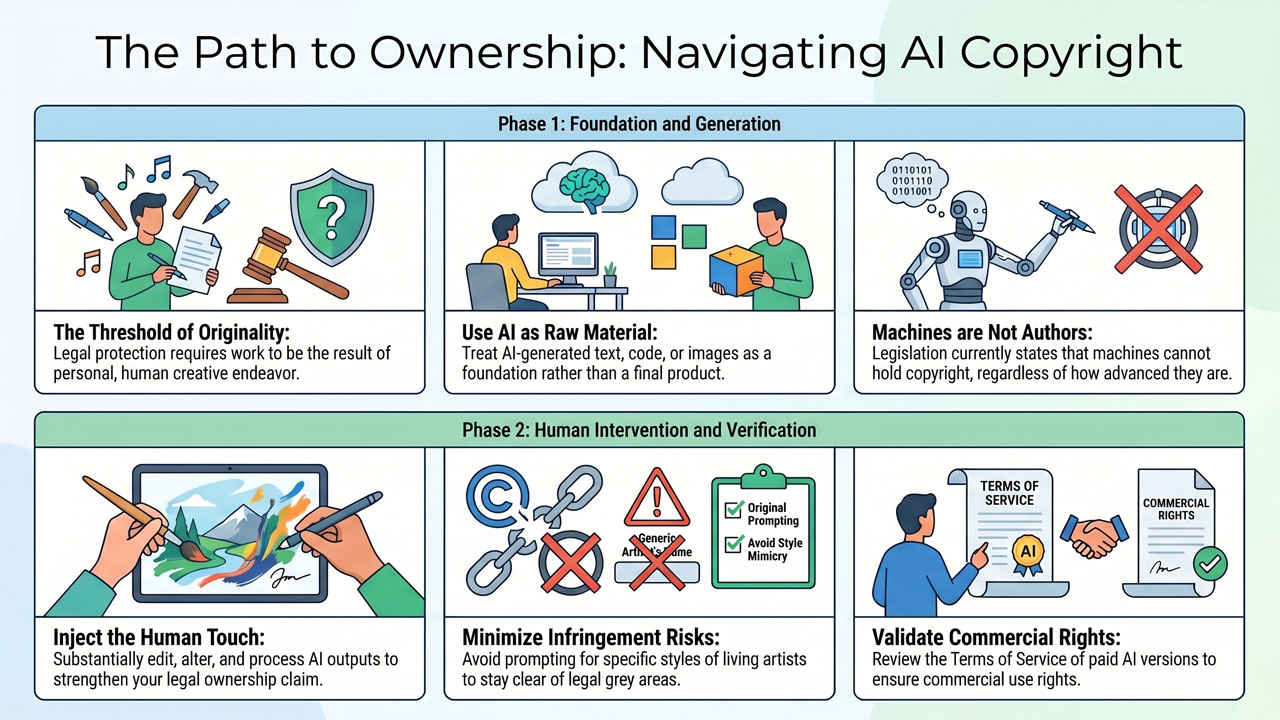
In many countries and within the EU, copyright is based on the principle of “threshold of originality”. This means that a work must be the result of a human being and their personal, creative endeavour to be protected by copyright law. A machine, regardless of how advanced it is, cannot in a legal sense be an “author”. This creates an interesting and sometimes problematic situation: content that is generated entirely by an AI currently often lacks copyright protection. If you ask an AI to create a logo for your new company, you may discover that it is difficult to stop a competitor from using a similar image, as the logo was not created by a human hand.
Another perspective is the risk of infringing upon the rights of others. Since AI models are trained on massive amounts of data from the internet, there is a risk that the AI generates something that is too close to an already existing, copyrighted work. If you ask the AI to “draw a picture in exactly the same style as a living, well-known artist”, you are moving into a grey area where legal precedent is still taking shape.
To navigate this safely, you should view AI-generated material as a fantastic foundation or raw material. The more you edit, alter, and add your own human touch to what the AI produces, the stronger your claim becomes that it is indeed your own work. For professional use, it is also important to read the terms of service for the specific AI service you are using. Many paid services (Enterprise versions) grant you the right to use the results commercially, but they can rarely guarantee that the content is unique or that it cannot be legally challenged. The golden rule is to use AI to accelerate your creativity, but to always inject enough human judgement and unique processing for the result to become your own.