Navigating AI Regulation: A Global Perspective
Whilst many participants in this course are based outside of Europe, a comprehensive understanding of the EU AI Act remains highly advantageous.
As the world’s first major horizontal legal framework for Artificial Intelligence, it is increasingly viewed as the global benchmark for safety, ethics, and accountability.
Regarding regulatory compliance, we advise the following approach:
-
Prioritise Local Legislation: If your specific region or jurisdiction has established AI regulations, these should always be your primary point of reference.
-
The EU AI Act as a Best-Practice Framework: In regions where specific AI legislation has yet to be implemented, the EU AI Act serves as an excellent, rigorous standard. Following its principles ensures that your AI initiatives are built upon a foundation of transparency and risk management that is likely to align with future global requirements.
The EU AI Act
By familiarising yourself with these standards, you position yourself at the forefront of responsible AI development, regardless of your geographical location.
For AI to be used broadly and safely in society, rules of play are required. Much of the debate in recent years has centred around the fear of a “Wild West” scenario – that technology is moving faster than legislation and that unregulated AI could threaten everything from democratic elections to personal privacy. The answer to this challenge is the EU AI Act. This is a historic document, as it is the world’s very first comprehensive legislation regarding artificial intelligence, and it affects how technology companies and users must operate across Europe.
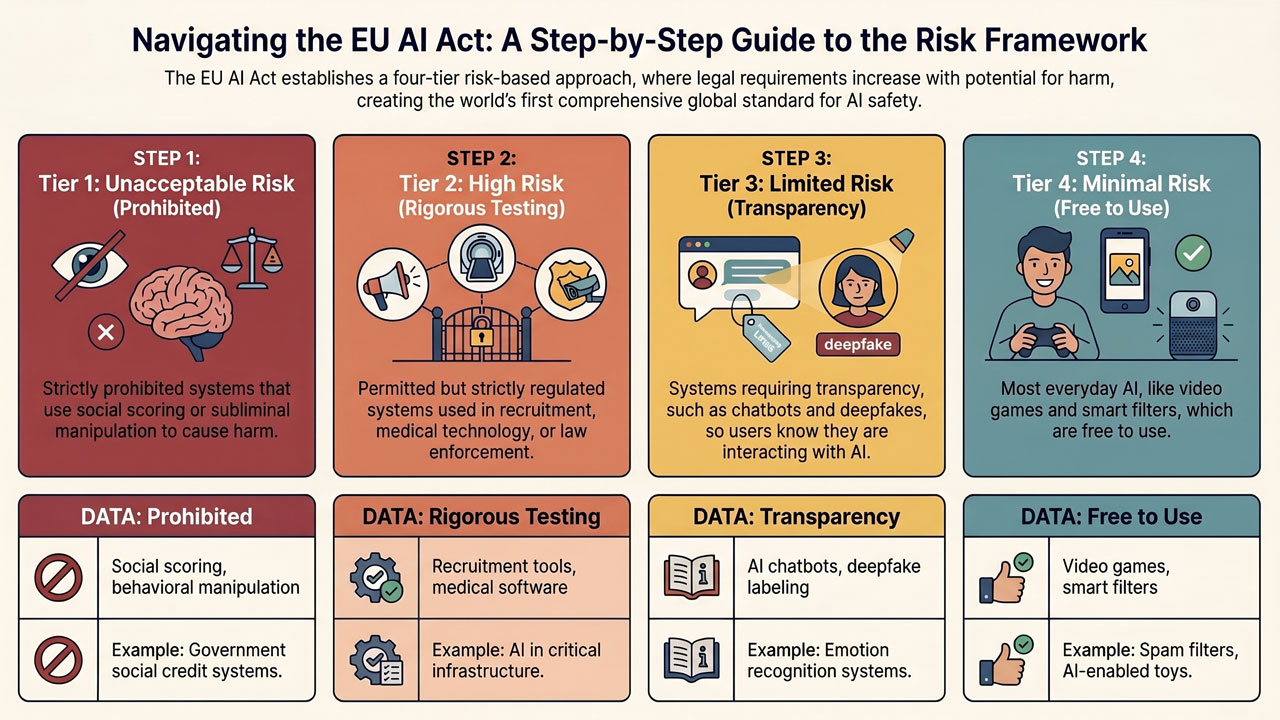
You do not need to be a lawyer to understand the AI Act. The cornerstone of the entire regulatory framework is built upon a risk-based approach. This means that the EU has recognised that not all AI is the same. Using AI to sort your spam is not the same as using AI to analyse X-rays or determine who should be granted a bank loan. The regulation therefore divides AI systems into a tier system with four different risk levels, and the requirements increase dramatically the higher up the tier the system is situated:
-
Unacceptable risk (Prohibited systems): At the very top, we find AI systems that pose a direct threat to people’s safety, rights, or fundamental democratic values. These are strictly prohibited in the EU. Examples of this include systems for “social scoring” of citizens based on their behaviour, or AI that uses subliminal techniques to manipulate human behaviour and cause harm.
-
High risk (Strict requirements): Here we find AI that directly affects people’s life-altering decisions or safety. This could involve AI used to filter candidates in a recruitment process, software within medical technology, or systems used by the police and judiciary. These systems are permitted, but they must undergo rigorous testing. The companies behind them must have logging, extremely high data security, transparent algorithms and – above all – human oversight.
-
Limited risk (Transparency requirements): At this level, it is about our right as citizens to know when we are interacting with a machine. If a business uses an AI chatbot for customer service, it must clearly state that the customer is not speaking with a real human being. Here there are also requirements for labelling “deepfakes” (AI-generated images or videos that appear completely real) so that people are not deceived by false information.
-
Minimal risk (Free to use): The majority of the AI systems we interact with in our everyday lives fall into this category. This includes AI-generated video games, most generative text tools for everyday use, and smart filters. These systems can be used freely without new, burdensome legal requirements from the regulation.
What does this comprehensive legislation mean for you in your working day, then? Above all, it means security. It guarantees that the AI systems your organisation purchases and uses have undergone an independent review if they concern sensitive areas, and that large platforms must take responsibility for how their algorithms affect society. It protects your fundamental rights. By understanding the main features of the EU AI Act, you gain an important piece of the puzzle for your “AI Driving Licence” – you not only know how to use the technology, but also that there is a safety net ensuring that the technology is developed to serve humanity, and not vice versa.