Introduction to Generative AI
Welcome to the future, which is actually already here. Generative Artificial Intelligence (AI) is undoubtedly the largest and fastest technological shift since the introduction of the internet or the smartphone. But what is it, exactly? To truly grasp the magnitude of generative AI, it is helpful to first understand how it differs from the “classical” AI that has been operating in the background of our lives for several decades. Traditional AI is primarily analytical and sorting. Consider the smart algorithms that recommend films to you on a Saturday evening, the functions that detect and block spam in your inbox, or the banking systems that instantaneously flag a suspicious card transaction on the other side of the world. These systems are trained to recognise patterns and categorise existing information.
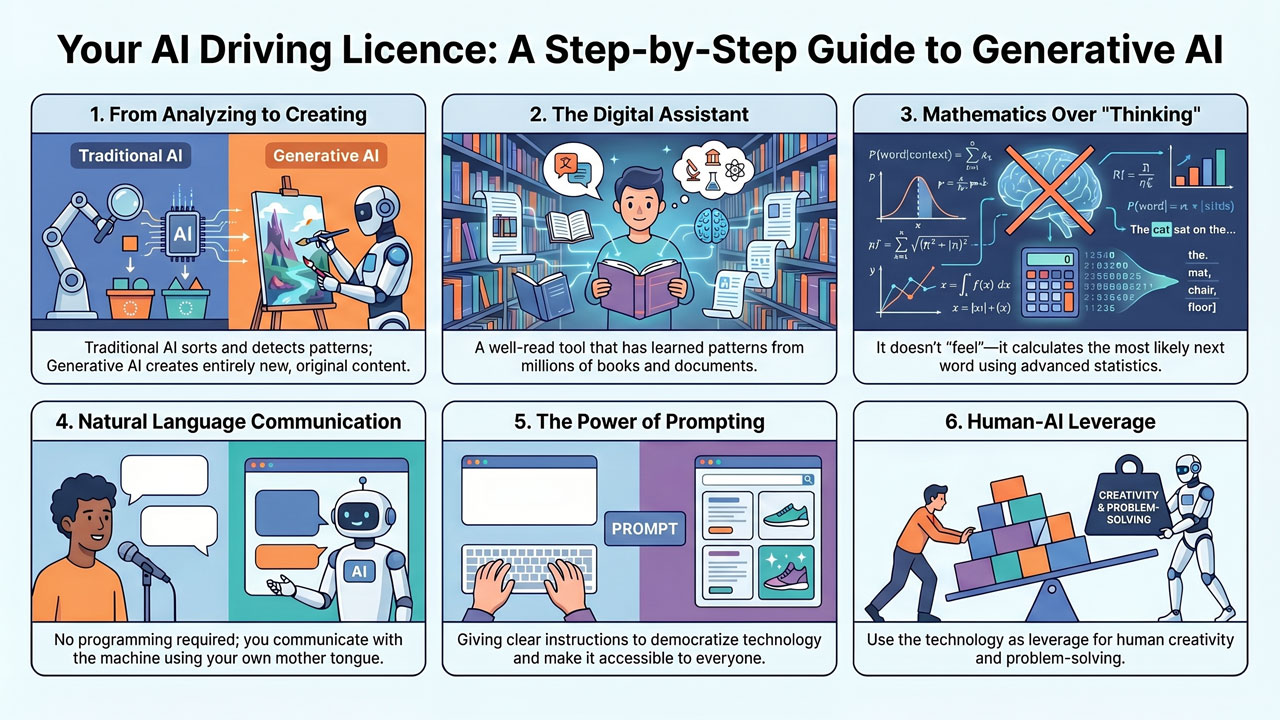
Generative AI, on the other hand, is creative. It is not content with merely analysing data – it utilises the enormous quantities of patterns and structures it has learned to generate entirely new, original content. Whether it involves authoring an article, composing a piece of music, writing complex programming code, creating a hyper-realistic image, or producing a video clip, it creates something from scratch based on your instructions.
To render the technology slightly less abstract, you can imagine an exceptionally well-read and creative assistant. This digital assistant has ploughed through millions of books, scientific articles, web pages, and documents. It knows what a poem by Karin Boye looks like, how an annual report is structured, and how a formal email in German should be formulated. When you ask this assistant to “write a polite email to a dissatisfied customer to apologise for a late delivery”, it does not go to an archive and copy a ready-made template. Instead, it employs an incredibly advanced form of statistics. It calculates, word by word and sentence by sentence, what the next word ought to be to best fulfil your request. It does not “think” or “feel” as we humans do, but it is an undisputed master of the mathematical patterns and structures of language.
Perhaps the greatest revolution with generative AI is that we have been given an entirely new way to communicate with our computers. You no longer need to learn a complicated programming language or navigate difficult menus. Instead, you communicate with the machine in your own mother tongue – just as in a perfectly ordinary chat. This is referred to as “prompting” (giving instructions to the AI), and it has fundamentally democratised the technology and made it accessible to absolutely everyone. Understanding these fundamental principles is the very first and most important step on the journey towards your AI Driving Licence. Generative AI is not about magic, sci-fi, or thinking robots; it is a powerful and advanced tool. By feeding it with the right prerequisites and asking the right questions, we can use the technology as leverage for our own human creativity, problem-solving ability, and knowledge.